Tuesday, November 30, 2010

All Sorts of Events

In case you're wondering what I've been up to, here are a few things:

1) The Warrior Dash on October 30th

This 3.5 mile run involved numerous obstacles and was lots of fun. Here's a great picture of me jumping over fire, but I'm unwilling to pay for a full-size version.


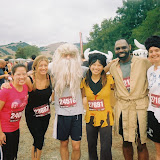
And here's the rest of the photos featuring some TNT running buddies dressed as zombies:

WarriorDash2010


2) Making Strides Against Breast Cancer November 6th

Honoring my amazing mother:


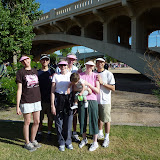
With the support of numerous phenomenal friends!


3) Women's Half Marathon November 7th

Enjoying 13.1 miles with my amazing friend Candice who has an 8 month old and doesn't look it!


More pictures from the AZ events here:

November Visit to AZ


I had a fabulous time! Thanks so much everyone!

4) Marin Turkey Trot


Matt and I's first "race" together since the Golden Gate Park Turkey Trot last Thanksgiving. And he beat me!

The Twelve Days of Bookmas Giveaway

To celebrate the holidays BookEnds is going to host a 12 Days of Bookmas Giveaway, a book giveaway just in time for holiday gift-giving or as a little treat for yourself.

Since we close over the holidays, and we want to make sure you receive your prizes in plenty of time to place under the tree, the contest will actually be held the first 12 days of December, beginning on December 1 and ending on December 16 (posts will run Monday through Friday only).

On each day we’ll post a clue, riddle, or quiz for readers to answer. The first reader to post the correct answer in the comment section will win the prize of the day. Don’t think you’re getting off easy, though. These aren’t going to be simple quizzes. They’re going to take a little research on your part, because finding the perfect gift always means a bit of a hunt.

In order to bring everyone into the fun, we’ve asked our clients to participate. They’ll know the answer (and no, they will not give in to bribes) and will be posting clues all over the Internet, clues that can be found through Twitter, Facebook, blogs, websites, or any other social media outlet we haven’t thought of. Participating clients and their contact information (where their clues can be found) will be listed on each day’s post.

A few rules & extra hints:

If you’re a Twitter follower, note that we’ll be using the hashtag #12daysbooks

There will only be one winner each day and each person/address is only eligible to win once throughout the course of the contest.

Prizes will be at the discretion of BookEnds.

Winners will be announced on the following day’s blog.

And to make things extra special, a number of our clients will be running side contests, so don’t just go to one or two links, check them all out to double your prize.

And finally, a sneak preview of where clues can be found (in no particular order):

Lorna Barrett

Bob Phibbs, The Retail Doctor
Sally MacKenzie
Paige Shelton
Amy Patricia Meade
Ellery Adams
Angie Fox
Gina Robinson
Erin Kellison
Bill Crider
Elizabeth Lynn Casey
Bella Andre
Elizabeth Amber
Krista Davis
Heather Webber
Avery Aames
Kim Lenox
Joyce and Jim Lavene
C. C. Hunter
Cricket McCrae
Anita Howard
Wendy Lyn Watson
Erika Chase
Elizabeth Joy Arnold


Jessica

Nope, the printed word's not doomed


Technology is terrific, isn’t it? At least when it works.

I don’t have much time to read these days, at least not the “sitting down and turning the pages of a book” kind of reading. That’s hard for a girl like me, who used to scarf down three or four or even five books a week back when life was saner.
As a kid, I’d always read at least two books at a time – that way, if Mama confiscated one book when she caught me reading instead of doing my chores, then I’d have a back-up. I also learned, by sheer necessity, that if I were going to read at my house, I needed to speed read.

But even speed readers need time to finish a book. Way back when my to-do list started pushing my reading time out the window, I realized that I was cranky and grouchy and just plain hard to live with when I didn’t ingest the printed word.
So I picked up an audio book from the library to listen to in my car. Back then, the books were on cassette tapes (yes, I do realize that tells you that I am old enough to have driven a car with a cassette tape deck.) It took me a little while to get used to the weird transition of having someone read to you – it’s not as passive as TV, but I did miss the interaction with the printed word.

But at least I was “reading” after a sort, and doing it during a time when I wasn’t accomplishing much else. I hung on through bad narrators and shredded tapes, because at last I was getting my “fix.”

Fast-forward through CDs – much better than cassette tapes – and onto to the lovely, lovely leap of an iPod and free downloads from the library. No more CDs to worry about, no more having to leave the story’s characters hanging off a cliff – now I could just unhook my iPod and take it in with me, to listen to while I folded clothes or cooked supper or vacuumed. (Ha, you say, that’s a lie, because we know you hate to vacuum.)

I’d noticed though that sometimes in the downloading, though, that the last little bit of a chapter would get chopped off. No problem. I could usually figure out the last little bit as I listened to the first part of the next chapter.
But then I outlasted my odds. I came to the end of a book, and bam! The last little bit, when I was supposed to find out whether the guy was going to get the girl, it was all gone.

That just about drove me crazy. Still, I can’t knock the fact that I’ve gotten loads of good books – complete books with no glitches – downloaded from the library. I guess, though, that tells me that the printed book will never die, as at least it doesn’t require batteries and the page isn’t dependent on kilobytes cooperating.

Monday, November 29, 2010

Strictly Agent Territory

I’m curious about the opinion you and Kim have about the rise in e-books and the rights therein. Is this an issue authors should pay closer attention to, or is it strictly agent territory—or perhaps, is it the responsibility of both parties?

There is nothing in this business that is “strictly agent territory.” As the author and owner of your business (your author brand), it is imperative that you learn about the business and keep yourself apprised of what is going on. When I look at those authors who have truly achieved success, there is one thing all of them have in common, and that’s knowledge of publishing as a business. That doesn’t mean they necessarily understand every clause in a contract (a smart author also surrounds herself with smart people), but she does make an effort to understand the contract as a whole, the rights she’s licensing to others, and what the options are for her career. She works as a team with those smart people she’s hired, which means she has conversations with her agent about the contract and the rights that are being licensed, she discusses design and style with her website designer, and she works hand in hand with her publicist to come up with the next brilliant publicity idea.

So the answer is a resounding: It’s the responsibility of both parties to understand and seek knowledge about not just digital rights, but all rights as they pertain to the book.


Jessica

Not Dead, Just Buried


Nope. I'm not dead. Just buried.

I know the blog-stage has been darkened for a bit, and this is not even a proper blog post in and of itself.

But it's been a crazy roller coaster ride, what with me getting used to the new dayjob, and the holidays, and trying to find my way.

We've all got the same 24 hours in a day. We may not have the same amount of money, we may not have the same amount of talent, but we've ALL had EXACTLY 24 hours in the past day. That being the case, I'm really wondering what I blew my 24 hours on, because I honestly can't see that I've done much besides survive.

Sometimes, though, you get a gold star for just surviving, just treading water until the Coast Guard can scoop you out of the murky deep. And that's how I've felt lately. Sooner or later, though, just surviving isn't enough.

I read something once that made me realize how useful priorities were in making life decisions, no matter what those decisions involved: family, money, time, stuff. I believe it was a Dr. Phil book.

I'll roughly paraphrase here: say you wanted to go to Miami, and you started from DC. You're tooling down the interstate, and you take a wrong turn. Instead of going down I-95, now you're heading west. You go about two miles down that road, realize what you've done, and say, "Self, I've got to turn around."

Now a flashback to your dreaded word problems in math class. Just how far off course have you strayed? Nope, it's not just the two miles ... it's the two miles down the wrong road, the two miles back to the initial wrong turn, and the fact that you could be at least four miles further along your path and closer to your goal if you hadn't made the wrong turn in the first place.

The thing about priorities is that they make you ask this question: Is this choice leading me closer to my goal? Or further away?

Theoretically in a perfect world, we'd never choose a priority that takes us away from our goal. But we aren't computers. We don't make calculated choices. Our choices are steeped in emotion -- which is not all bad. We don't even, sometimes, recognize that whatever the choice is DOES affect our priorities.

But it's back to those 24 hours in a day. Like my "stuff" in my closets, only so much can be jammed into those 24 hours. I have to figure out what I want to get accomplished long-term. And then I have to be disciplined about using my time wisely.

That's what I'm doing now -- my brain is busy cogitating the top three things I want to get accomplished in the next year. After that, I'll be able to give a flint-hearted, cold-eyed stare to a decision and say, "Yup, that's gonna help me get there," or "Nope, that's taking me west when I wanna go south."

Sunday, November 28, 2010

Seasons - Marianne Jones, artwork by Karen Reinikka

I have been looking forward to writing this review, though I should probably say that my review may not be completely unbiased - Marianne Jones is my friend's aunt and Karen Reinikka is her mother!

This collection of poems and watercolours began as a project to raise money for the Red Cross School Nutrition Program which provides healthy breakfasts, lunches, and snacks to children and youth in Thunder Bay and Northwestern Ontario. Marianne Jones (who is a published poet in her own right) wrote 12 poems, covering the four seasons, and her sister Karen Reinikka painted 8 watercolours to illustrate the poems. I bought the "deluxe edition" that is bound in four separate volumes in a cloth-bound wrapper, however there is also a "chapbook" available with all of the poems and paintings in one volume. It is a very limited run, with only 26 copies of the deluxe edition printed (I have copy "K"), and 50 copies of the chapbook.

The poems are all short - many of them just a few lines - but beautifully evocative of this part of the world. A few well-chosen words can distill the essence of the feelings that the change of seasons bring. And the watercolour paintings compliment the poems seamlessly.

The books were designed, printed, and hand-bound by Chris and Laurie Wright of BookWrights Bindery in Red Rock (just east of Thunder Bay), friends of the Joneses and Reinikkas. The feel of the paper in the books is so delicate that my hands felt almost too rough to handle them.

As we are rapidly approaching the shortest day of the year, I want to end this post with one of my favourite poems from the Summer section. I can just picture the drive into town along Dog Lake Road, late on a summer night when the sun doesn't set until after 10.

A Little Night Music

Headlights illumine the yellow snake
splitting the road that leads home.
Above the road stars dance.
They dance to
the jazzy beat of the night.
Dipper twists and jives.
Roadside grasses sway ghostly.
They hear
the far-off song of the sky.
It's a long way
from earth to heaven,
a long way
to catch
those crazy constellations.

This counts as another book towards The Canadian Book Challenge at The Book Mine Set.

Email Fail

There's nothing like a computer crash to really mess with your day. Mine happened on Thanksgiving morning. Luckily it was only my email and only a week's worth of material. That being said, all email, sent and received, was lost between the dates of November 19-26 which means I can't be sure which email I might have responded to during that time and I've lost any email I received during that time.

If you had sent requested material between the dates of November 19-26 please resend. It's gone. If you queried during that time and have not yet received a response I'm afraid that I'm simply going to ask you to requery after January 4 (since I'm currently closed to queries).

If I reply twice to your query I apologize in advance.

Thank you for understanding and I apologize again to those caught in the crash.

--Jessica

Wednesday, November 24, 2010

Happy Thanksgiving!

I have been completely crazed the past two months, crazed in a good way. In the months of October and November I have negotiated 11 contracts for a total of 18 books. It’s been a whirlwind to say the least, but it wasn’t until one of my authors said to me, “Are you happy about the deal?” that I realized what a whirlwind it has been.

I was so busy making the deals that I didn’t even have time to celebrate the deals, so that’s what I’m going to do this weekend. Here in the United States it’s Thanksgiving weekend (because one day is never enough), and I certainly have a lot to be thankful for. Eleven new contracts for one thing, but also the authors who make it all possible and who, really, make me look good.

I’m also thankful for my family and friends, those who will be joining me at the Thanksgiving table and those celebrating in other locations, because when one client asked “How do you do it all?” I only had one answer, and that’s that I have a family who takes good care of me. There’s no doubt that without them I wouldn’t be doing it all.

This weekend I’m going to take the time to reflect and give thanks for all the good things in my life, of which there are many. I’m going to cook a vegetarian, gluten-free Thanksgiving feast, enjoy cranberry martinis with those I love, and read a book that I don’t have to edit, critique, or give any feedback on.

Happy Thanksgiving to all. We’ll see you on Monday.

Jessica

Tuesday, November 23, 2010

Building Your Career on Kindle, the Published

Yesterday I shared some of my thoughts on unpublished authors self-epublishing as a way to launch their careers. Hopefully I was able to present a fair and balanced portrait of my thoughts on the subject. Today I want to continue that discussion by looking at what self-epublishing can do for published authors.

Just as unpublished authors see Kindle and other self-epublishing opportunities as a way to launch a career, published authors see self-epublishing as an opportunity to keep books that might have gone out of print in print or publish books that haven’t yet been published.

There’s no doubt this can be a wonderful opportunity for many, and we’ve seen some of those success stories right here at BookEnds. Angie Fox posted about her own experience in her blog post Taking Charge of Your Career, and author Bella Andre has responded to her readers by self-epublishing some of her erotic romances. That being said, neither of these authors made the decision to self-epublish lightly. Both carefully considered why they were doing it and worked very, very hard to ensure that the product they were putting out was just as good as, if not better than, any book they’d ever written or published traditionally. Most important, they have continued to keep their author brand in mind and are always working to make sure that their next book is always better than the last, whether it’s been self-epublished or traditionally published.

When it comes to readers you are only as good as your last book, and by last book I mean the last book they read. So even if your most recently written title is the one coming out from Big Name Publishing House, the one readers will remember and base future buying decisions on is the one they last purchased. So while self-epublishing can be an exciting way to move those books out from under your bed, you need to consider whether that’s the best decision for your career.

Let’s look at it his way: You have a series of historical romances you’re publishing with Publisher XYZ and they’re doing great. Your career is on the rise and readers love you, so you start thinking of all of those paranormal romances you wrote years ago. You still love those books and why wouldn’t your readers? They’ve made it clear they can’t get enough of you. So you dust them off and send them out to self-epublish. But those books aren’t as good as your historical romances. You might love them, but let’s face it, you’ve grown a lot in the last 10 years and the reason you are having so much success is because you’ve worked hard to perfect your craft. You also have an editor who works hard with you. You constantly praise her for her brilliant mind and editorial eye. You can’t say enough about how good she makes you look, but obviously if you’re self-publishing she won’t be involved with this book. And it shows. Of course readers snatch up your books because they love you, but they’re disappointed. The books aren’t what they’ve come to expect from you, and now they feel like they’ve wasted their hard-earned money and time reading books they found unsatisfying. Your next historical romance is published and sales drop. Your publisher can’t figure it out, they blame it on the cover, but the truth is that the readers have moved on. They don’t want to risk wasting more money or more time so they’ve found another author to follow.

Is this a doomsday scenario? Yes, it is, and I realize that, but it seems we’ve read so many stories lately about authors making millions by self-epublishing that I wanted to use an extreme example to remind you not why self-epublishing is bad, because I don’t think it is, but why you need to carefully consider what you’re putting out. It’s not the fact that you self-epublished your paranormal romances that’s the problem, it’s the fact that you’ve decided to put out a product that simply wasn’t as good as what’s already on the market. And that’s what I want published authors to consider.

Self-epublishing can be a fabulous way for authors to keep in touch with their readers and meet the demands of their readers for new books. It’s also a great way to make more money, but it also needs to be considered as carefully as any business decision you make. Think of how much you thought about the offer that came in from your publisher (or how much your agent thought about it and talked about it with you), think about how hard your agent worked to negotiate the perfect publishing contract for you and how carefully you considered each step of the process. Are you doing the same with your self-epublishing decision? You need to.

As of yet, publishers haven’t figured out a way to factor epublishing sales into the numbers they run when making an offer to an author. That’s going to change, it’s going to have to change. It won’t be long before those numbers become more important than the sales you’re seeing in print, and just as they can positively impact the offer a publisher makes, they can have a negative impact as well. If sales are slow or small on your epublished books, publishers are going to look at that as an indicator of how well they’ll be able to sell the book. In fact, it’s a much better indicator than we have now because these are actual sales to readers and not just sales to bookstores with the possibility of returns. So if you’re between publishers but looking to get back in with a traditional house, really slow sales, or bad sales, can have an impact on whether a publisher considers offering. Why wouldn’t it? It’s an easy way for them to test market you.

Another reason authors are self-epublishing is that they have heard there is a lot more money to be made by doing it on their own than by going with traditional publishers. In some cases this might be right and has proven right, in others you’re just another book among thousands that readers have to sort through. There’s no doubt that epublishing is growing by the minute and that more and more people are finding this new way to read. That being said, just because it exists doesn’t mean it will be a financial boon for you. J. A. Konrath has been wonderful in sharing his numbers with the public, but the truth is that he had a strong brand before he self-epublished and has clearly worked very hard to continue building that brand. Let’s face it, he’s become the poster child of self-epublishing, and if anything, out of simple curiosity, hundreds of readers are buying his book just to see what the hype is all about. Are you willing to put that same time and energy into your product? Or, here’s another thought: Do you have the epublishing readership to support such a venture?

If you’re a published author I have no doubt you’re looking at the opportunities self-epublishing offers and considering it. It’s interesting, it’s different, and certainly when reading about the success others are having it’s tempting. It’s also a career decision and not a lark. Anytime you put out a product it’s part of your brand and needs to be considered as such. Do you think Coca-Cola put out Dasani water on a whim just because everyone else was doing it? Not likely. Whether or not people know Dasani is a Coke brand, they would find out very quickly if it failed. Obviously I’m a supporter of self-epublishing to help grow my authors’ careers, but only if it’s truly a growth move and not simply a way to get everything out there published.

Jessica

Monday, November 22, 2010

Launching Your Career Via Kindle, the Unpublished

What is your thought about authors who publish on Kindle? I first became aware that authors were doing this with their backlist about a year ago. Kindle makes it easy by offering a 70% royalty rate at a certain price point. Then J.A. Konrath announced she was releasing a new title on Kindle. That seemed to open the floodgates. Now, I know so many multi-pubbed authors who are not only selling to NY, they are releasing their backlist and even new fiction on Kindle as well.

What do agents think about this new trend of authors self-pubbing through Kindle? In your opinion, does it harm us? Help us? Does it affect the way you look at prospective authors?


This is a post I’ve been wanting to do for some time, but knowing it would take a lot of thought and work, it took me a while to get my thoughts together or, more to the point, my thoughts on paper.

Today’s post is going to be Part One of a two-part piece on self-publishing electronically, whether it’s through Kindle or another format. Today’s post will focus on the unpublished author, as per the reader’s question, while tomorrow’s will take a look at the published author who wants to use electronic self-publishing as a way to build or enhance an already successful career.

It’s a really interesting time in publishing. Self-published electronic books are changing the way many of us think about books and giving authors quick and easy ways to get their books out to readers without the help of traditional publishers or agents. And there is no doubt that we’re seeing success stories from authors who are doing it their own way and on their own. That being said, we’ve seen this before.

When I first launched BookEnds 10+ years ago there was something hot and new on the scene, something that was going to revolutionize the way we publish and finally get rid of those “gatekeepers,” otherwise known as agents and editors. That something was POD (print on demand). Sites like iUniverse and Lulu were popping up everywhere and for a mere $99 (or something like that) authors could publish their books and find an audience themselves. The talk at the time was that we didn’t need agents anymore, we don’t need editors. Readers are going to be able to make the decision about what books should and shouldn’t be published, and some bookstores were even working with these sites to carry the books. Sound familiar?

Just as there is today, there were success stories with POD, authors who went out there and did it their own way and found readers, a lot of readers. Eventually a number of those authors were picked up by what we’re calling today “traditional publishers.” The truth, though, is that, just like today, there were many, many more authors who floundered, sold very few copies, and never had anything near the success they dreamed of.

It’s true that self-epublishing is different in the fact that you are guaranteed “bookstore” space since most of the opportunities available are directly through the sites readers are already going to for their books. Right there you see more potential for success than you did with POD. And there’s no doubt that it’s appealing to sidestep the tedious process of finding an agent and finding a publisher, but is it really easier to find a reader? I’m not so sure. Remember, just because you put the book out there doesn’t mean the readers will come. Think of it this way: If every single person who is querying me this week (that’s 300+ people) decides to epublish on their own, it’s not going to take more than a week before the market is flooded with books, and when readers are overwhelmed, what do you think they’re most likely to do? My guess is go back to those books that are tried and true, those authors they already know will deliver a good read. Heck, there might even become a time when readers rely on the brand name of publishers to help them weed through the mass of books to choose those they feel will be quality books.

Now don’t get me wrong, I’m not against self-epublishing, not by a long shot, but I think it’s important that authors carefully consider all sides of the story before jumping in, just as I hope you would carefully review any publishing contract before signing. There’s definitely a time and place when self-publishing through places like Kindle can be beneficial to an author, and I have authors who I think it can help, but I also think you need to consider exactly what you want out of publishing or epublishing and whether putting everything you write out there is necessarily the best thing. Frankly, this is the exact same advice I gave five or ten years ago when authors were asking my opinion on self-publishing or POD publishing. What are your goals as an author and your dreams for this book?

Lately I’ve read a lot of blog posts and articles on self-epublishing and how it’s the downfall of traditional publishers and that we’re all terrified of this new world. I suppose there are some who are terrified, in the same way there were people who were terrified to give up the typewriter, wordperfect, or put a credit card online. You might be nervous about change, but eventually you’re going to have to take that step. That being said, I feel that some of the articles I’ve read have been incredibly biased and misleading. They praise the authors who have had major successes in the self-epublishing world and throw their names around like it’s so easy. Frankly, I think that’s a discredit to those authors like J. A. Konrath who have worked hard to achieve the success they’ve achieved, whether by self-publishing through Kindle or finding a home with a traditional publisher.

J. A. Konrath created quite a stir when he (not she) announced his deal on Kindle and regularly discusses his thoughts on epublishing, but this world isn’t necessarily for everyone. Joe has a following, he has an audience, and most important, Joe works damn hard to constantly promote his brand. In my opinion, he’s an exception to what’s happening, not the rule. Trust me, Joe has a lot of great points, and the biggest is the amount of money one can make going directly to places like Kindle rather than through a traditional publisher. That being said, can you make the money if no one buys your books? Joe was selling books to readers well before he entered the self-epublishing world, he had a fan base, and people were hungry to read more of what he had written. Let me put it this way: For every success story like J. A. Konrath, there are hundreds of authors who put a book out on their own, only to see a hundred or so sales to friends and family and then nothing.

Do I think it’s a mistake to go out on your own? No, but I do think you need to be aware of the pitfalls, and one of the biggest is falling into a clump with thousands of other authors who have grown tired of the query process and are convinced that no one in publishing knows any better. I think self-epublishing is much easier for those with a recognizable audience already. J. A. Konrath has that and so does Seth Godin, another author who has decided to stop using traditional publishers and epublish on his own.

While self-epublishing is certainly different from POD, primarily because in self-epublishing you can actually get your book to readers through stores, I don’t think finding readers is any easier than finding a literary agent or publisher.

The world is changing and so is publishing. It’s an exciting time and frankly, with all the discussions that are happening, I’m not convinced anyone has touched on what the future will really be like just yet. Personally, I think it’s still going to include traditional publishers, editors, and agents, because who wouldn’t want a smart team of people on their side to help market, edit, and promote their book, and who wouldn’t want a business manager to help guide their career and take on some of the headaches that any business can create? I just think we’re going to see things happening in a different way.

To sum up (to really answer your question), because obviously there’s a lot I could continue to say, I think self-epublishing is a viable option if you know why you’re doing it. If your hope or plan is to build your career and use it as a way to get out your debut novel, you might want to either rethink whether that’s the best way, or seriously consider how much work you are willing to put into it. In other words, do you have the time (and money) to spend marketing and promoting the book like you would really need to do to find readers? If, however, you have a story you love, that you want told, and you just want it out there, I certainly think it’s a great alternative to “traditional publishing.”

Jessica

Fore!


I'm tossing again.

Back when I first started claiming home office expenses related to my writing on my income tax, I had a lightbulb moment of why my house was so cluttered. In order to claim expenses, you have to provide what proportion of your home office is of your total heated square footage, right?

So I did. And I was aghast to find out that my heated square footage was about 1, 100 square feet. No wonder I was walking around piles of stuff with no home. I joked with The Husband that I had 3,300 square feet of junk crammed in 1,100 square feet.

Maybe we don't have quite 3,300 square feet of junk, but we have way too much stuff for such a little house. So since then, I've been going through spells of decluttering, with the hope of one day getting down to a Zen-like bareness.

To that end, I checked out a book from the library called IT'S ALL TOO MUCH, by my hero of decluttering, Peter Walsh, the guy from CLEAN SWEEP.

It's more of the same message -- you can't put three cubic feet of junk into one cubic foot of space -- but I like the way Walsh puts it. Sometimes I'm so dense that I have to hear the same message in about a million different permutations before it really sinks in.

His big push is that form should follow function. A person or family should decide what the mission is for a particular space, and then subtract out everything that doesn't promote that mission.

It was so basic and fundamental a principle that I put the book down and tackled the top of my bureau, a no-man's land of stuff that didn't really have a home. And I thought, as I did it, about life and writing.

Why is it that we tolerate so much clutter in our lives -- not just real, physical clutter, but "issue-type" clutter? We tip-toe around it and make what my mom used to refer to as "pig-paths" around the heaps. We can't do A because someone's feelings might get hurt, and we can't accomplish B until we accomplish A. We need X, but first we have to stop doing Y, just so we'll have the money or the time or the space for it.

Same thing in writing: it was such a lightbulb moment, a better way to look at it than the "kill your darlings" old saw that writing teachers always talk about. Instead of looking at your darlings, or as Peter Walsh calls clutter, your stuff, look at what you want to accomplish. What's keeping you from it?

So hopefully from now on, as I'm writing a scene or a chapter or a book, I can look at the purpose of a scene, the mission of it. What's that purpose? What am I hoping to accomplish? What do I need to get rid of to make that path clear?

In the meantime, I am back on the tossing wagon at home, so if you're hanging around my house, consider yourselves ordered to duck!

Saturday, November 20, 2010

A Book-ish Quote

The other day at the gym, I was listening to a podcast of Eleanor Wachtel interviewing J. M. Coetzee, Nobel Prize winning author and professor of literature. One question particularly caught my attention.

EW: "You've admitted a fondness for narrative pleasure, but you're also proficient in difficult and demanding literary theory. Which kind of reading do you do, the first time you go through a book?"

JMC: "I read for the story and have no shame about that. I wouldn't want to make a distinction between pleasure on the one hand and thought or analysis on the other. In fact, the ultimate fruit, I would say, of a literary education is to produce people to whom intellectual pleasure is possible; and people who are not ashamed of reading for the story because reading for the story, to them, is not just unthinking fun, but it is an intellectual pleasure as well. Writing has everything to do with pleasure, and the kind of thinking one does about writing has a great deal to do with pleasure as well."


Yay! There are other people out there who appreciate a good story, but also like to think about it as well!

On an completely unrelated note, I also want to put a plug in for my baby sister, who recently completed her first Ironman competition. You can read about her experiences here. A bookish connection? Reading books allows us to experience things that we may never experience in real life. And since most of us will never experience an Ironman, reading my sister's experience will allow us to experience it through her.

Friday, November 19, 2010

Lucy's Launderette

It is pretty obvious that a book published by "Red Dress Ink" is going to be Chick Lit, and this book lived up to expectations!

The last several books that I have read have been a bit on the heavy and serious side, so I was in need of something light and fluffy for a change.

There's not much to report on this book. Anyone who has ever read any chick lit knows that it tends to be very formulaeic, and this book followed the formula to a T. Heroine of the story watches her life fall to pieces around her, hits rock bottom, and then gradually watches everything come together in terms of love, work, and personal fulfillment. A good modern-day fairy tale. In this case, Lucy is an artist who hasn't painted in years, works as a glorified gopher at an art gallery with a sadistic boss and hasn't had a boyfriend in years. After an affair with a cruel artist, quitting her job, burying her beloved grandfather, and trying to support the aforementioned grandfather's pregnant girlfriend; she ends up painting again, running a successful business, and with a handsome, rich, kind boyfriend. End of story!

A friend gave me her copy of this book years ago, and I was saving it for a time when I needed something fluffy and brainless to read, and it worked for me this week. The big thing that I liked about it (and the reason why Renée passed it on to me) is that Lucy is a very likable character. In some chick lit that I've read, I can't stand the main character, and want to tell her to just suck it up and get on with it, but I can see myself being friends with Lucy-in-real-life.

So that's about it for this book. And now on to something a bit heavier (another M. G. Vassanji is up next, though a big box of books arrived in my mailbox yesterday).

I debated on whether this book could count towards the Canadian Book Challenge over at The Book Mine Set, since the author was born in England, grew up in Victoria, BC, and now lives in Italy (I had a similar issue with Emma Donoghue's Room); but I have decided that it does count (the deciding factor is that it is set in Vancouver!).

Query Status

It's only 9am and already the morning is getting away from me.

A quick update on where I am with submissions.

All queries have been answered up through November 2. Which I'm actually thrilled about. I feel very on top of things.

All requested material has been answered through the month of August. I currently have about about 50 proposals/full manuscripts I still need to read. I've been getting some fabulous queries lately and seem to be requesting more then usual. Let's hope there are a few winners in there.

And lastly, as of November 25 both Kim and I will be closing to queries for the rest of the year. November 24 will be our last day (for queries). We will both reopen on January 5.

My suggestion, if you don't have your query perfected, just hold on to it until January. If you happen to receive an offer of representation or and offer from a publisher during that time and you were really hoping to query me, send an email letting me know. That will really be the only exception to the "closed to queries" situation.

Have a great weekend!

--Jessica

Thursday, November 18, 2010

Making the Most of Media Exposure

Like many of your readers, I've worked on novels for years, with each new manuscript drawing more interest than the last. After my most recent manuscript, which drew 7 full requests, another dozen partial requests, but no offers, I decided to take a break from fiction and start writing a humor blog. Since June, I've posted one column a week.

Of course, there is nothing unique about an unpublished writer writing a blog, and there was nothing unique (other than I hope it was good) about mine until a month ago, when I sat down and wrote a short animated film called "So You Want to Go to Law School." I wrote the 5-minute script and used Xtranormal.com's free animation website to bring the video to life. I posted it to both Xtranormal's website and to YouTube.

The video has drawn nearly 1 million hits between the two sites. I've written a couple more videos, each of which have been relatively successful by YouTube standards (one has more than 10,000 hits, and the other is pushing 5,000 hits).

Now my question is this: How should I, as an aspiring novelist, take advantage of this sudden and unexpected burst of exposure?


My first reaction was how fun! If you’re willing to reveal your name, I would love it if you would jump into the comments section and post a link to your video. It sounds fun. And of course congratulations! How cool is that?

On to your question, how can an aspiring novelist take advantage of this exposure? You really can’t. I mean, certainly you can tell agents in your query about the video and provide a link and, like me, I’m sure many will be curious enough to click on the link and watch the video, but I’m afraid a viral video and a novel don’t necessarily have a connection. Let’s look at it this way: If you received a link to a viral video, no matter how hilarious you thought it was, would you automatically think you then had to buy the novel by the same creator? Probably not.

If, however, your book was nonfiction, giving humorous advice on going to law school: Score! There’s no doubt there’s a correlation then. Presumably a lot of your viewers are people who have gone through or are considering law school and get your humor. Buying a book that relates to the video would be a natural for them.

As for your novels: Seven full requests is amazing! Keep going, it sounds like you’re getting closer and closer with each new novel. My best advice is don’t give up now.


Jessica

Beyond perfection


The Kiddo has a Perfection Complex. I know this because I have to avert potential thermo-nuclear meltdowns on more occasions than I would like. She thinks she needs to make a 100 on every test. She thinks her hair has to be perfectly straight and glossy every day. She thinks her clothes need to match not only in color, but also to the exact temperature of recess -- never mind that recess is clocking in at 72 degrees, while school drop-off is clocking in at 39 degrees.

I swear, we don't push her. We don't nag. We don't even fuss. We don't have to. She beats herself up far more severely than we ever could.

But her perfection complex is not completely value-less for me. It provides me with a continual life lesson for me and my life and my writing.

When I was in middle school, I never worried about grades. I got what I got, which except for math were usually pretty good, at least a solid B.

Then a fateful moment occurred. A fellow student who had eeked out an A- was bewailing her grade. I glanced from the 83 or so that I'd scored on the same test and asked what the big deal was.

"My mama says that an A- is nearly a B, and a B- is nearly a C!" she explained.

I looked aghast at my 83, which was indeed numerically cheek-to-jowl with a C+. Quietly I folded my paper, tucked it in my messy book bag and vowed never again to have a B, save for math which came with a lifetime exclusion from any such blood oaths.

Fast-forward to high school. By then, even with a C in math (hey, that was a miracle for me, believe me!), I was making honor roll. Most of my grades were in the mid-90s.

That memory of the lowly station of an A minus, though, haunted me. If A minus was cheek-to-jowl with a B, then a 95, was neighbors with an A minus. That would not do.

My grade inflation slowly ratcheted upward, where no grade below a 98 in any subject save math would satisfy me. Oh, yes, I know. I was a tightly wound child.

It was college that saved me -- a psychology lecture on the Bell Curve. Suddenly I realized that statistically I was an aberration. Most people would fall within that heretofore hated C grade.

It was a lightbulb moment for me. No, I didn't start slacking and earning C's. But I stopped beating myself up about it so badly.

That's why seeing The Kiddo go down this same road is so painful for me -- especially when she started down it so much earlier than me.

Writers in particular can be just as severe on themselves. They kick and scream and wad up paper and let their internal editors convince them that any word they put to paper or commit to kilobytes is worthless.

Remember this, however. For most of the world, the prospect of writing a brief note to a teacher or a boss is only slightly less terrifying than having to speak in front of people. If you are a writer -- even a greenhorn newbie who still leans on adverbs and the passive tense -- you are already head and shoulders above most of the world.

So I give you the same advice that I give The Kiddo and myself: be kind to yourself. Be forgiving. Cut yourself a little slack. If you're doing the best that you can, it's all you can do ... and all anybody can expect of you.

Wednesday, November 17, 2010

Your Option Clause

I'm in what I consider to be a bit of a bind. My publisher has not been the most active with my book, and not the most communicative in general. I find it rough, but understand I signed a contract, it's technically their book now.

There's a Right of First Refusal clause in the contract, which I didn't think to be a big deal when I naively signed last year. However, I'm pretty much finished with the sequel to the book, and have to show them. The clause states nothing as to time frame or terms, simply says "We have the right of first refusal".

Does this mean I HAVE to sign the contract for the next book? Do I get to negotiate the contract if I do have to sign? What would be an appropriate amount of time to wait for their response? Am I totally out of luck, or does their simple statement give me some leeway?


And this is why you want a professional to help negotiate a contract.

It’s hard to tell you exactly what you have to do or don’t have to do without having the clause and the exact terms in front of me. That being said, I will do my best to explain the clause and what you are likely required to do.

An option clause, also called right of first refusal, means that you agree to give the publisher an exclusive look at your next book. Typically, the clause appears in all or most publisher contracts, and few publishers will agree to delete it entirely. They will, however, often agree to narrow it as much as possible, which is something an agent will do for you by adding things like a time frame and a description of “next work.”

However your option clause reads, it in no way means you are required to sign a contract for the next book. The publisher can’t force you to write for them. Typically it means they have the first right to read the book and make an offer, which you would then negotiate. At that point, you can decide either to stay with the publisher or pass on the offer and shop your book to other publishers.

As for time frame, I would give them 30 days to respond before harassing them for an answer.


Jessica

Unfathomable attraction


So just what IS the attraction of the UnDead?

Vampires and zombies have been so common for these past few years on deal announcements for book sales that I know someone out there thinks they're sexy -- lots and lots of someones, actually. My hat's off to any writers who can pull it off, that transformation of stinky zombies with falling off body parts or blood-sucking bats with legs into the guy you'd just die (pardon the pun, I just couldn't resist) to have a date with.

When I first started seeing the announcements, I thought, "Hmm, this is the new chick-lit fad." But vamps and the zombies that followed closely on the tails of their sexy black capes have hung around a lot longer than lattes, high heels and gripes about the workplace.

It's not that I'm judgmental. No, not at all. It's kind of like the "yawn" I feel when I see the blond-haired surfer god that some of my friends would drool over. Give me Pierce Brosnan over the newish James Bond fellow any old day.

Same thing with the UnDead. I simply cannot wrap my head around a concept like loving up on a dead-ish body, at least not long enough to suspend my disbelief and get into a book to give it a fair shake.

All of which makes this an amazingly good thing that I am not an editor -- boy, the sales I would have missed these past few years. And it seems that vamps and zombies have taken hold of the general population's consciousness, kind of like great white sharks did back in the JAWS days. For instance, a digital traffic sign in Arizona was reprogrammed by a zombie lover recently to warn, "Caution, Zombies Ahead."

I am reminded about the wisdom a furniture store owner shared with my parental units many years ago, about how he chose his inventory. "I pick a quarter of what I absolutely love, a quarter of what I absolutely despise, and the rest?" he said. "It's stuff I feel 'meh' about."

If editors chose it the same way, then they've certainly hit the jackpot with vampires and zombies ... and I would appreciate anyone who could educate me on the finer points of what makes the UnDead irresistable.

Tuesday, November 16, 2010

A Lot of Help from Friends

I’ve received a lot of requests for a follow-up post to the request for books from Valle Vista in Albuquerque, NM, and at last I’ve received a wonderful thank you to all who helped from the folks at the school:

I wanted to write and give you an update regarding the Read-O-Ween celebration at Valle Vista Elementary. As of today, the school has received book donations totaling over two thousand dollars, and more books continue to arrive!

The students and families in our community were touched by the fact that people from so far away cared enough about their success to send them books. Each child who attended Read-O-Ween went home with a new book to call their own, and the books that continue to arrive will be given to students as they participate in the school’s nightly reading program.

Thank you so much for these generous and meaningful gifts. The event was a huge success thanks in part to you and readers of your blog. I wish I could bake cookies for each and every one of you!

With thanks and appreciation,

Kris


I would like to echo Kris’s words when she said, My faith that the overwhelming majority of people are genuinely good and kind and want to make a difference in their world was totally confirmed by this event.

Thank you, thank you all who participated. Whether you sent a book or just passed the word along, you helped contribute to a child’s love of reading.


Jessica

Forward, MARCH


Lots of folks are hopping on the NANO bandwagon this month, and I wish them well. The whole spirit of NANO is to write a novel (or at least a good start) during the month of November, which requires you to fire your internal editor (or at least give her a month-long vacation if she's like my internal editor and won't be fired).

I've written the first draft of a novel in a month -- a full length, 80K word novel, so I know it can be done. Frequently the best approach for me in writing IS to write in a blitzkrieg session, getting it all done down in a month. Only then do I go back and tear it apart and revise it.

This month, though, it just doesn't seem doable, so I'm standing on the wharf, waving goodbye to all those aboard the NANO ship. I wish them bon voyage, but, what with a new dayjob and getting settled into a new dayjob schedule, I've just got too much baggage to go trucking across the gangway onto Good Ship NANO this year.

Still, I highly recommend it. Even if you can't do NANO in November, with the rest of the nation, take a look at your calendar, pick the least busy month (preferably one with 31 days), and set that aside for YOUR NANO.

The thing about writing, the thing that I've experienced first hand many times, is that the process of writing a novel bears a striking resemblance to walking in thigh-deep muck. As long as you keep moving, you're fine. The going can be slow, your steps frequently inelegant, but progress is assured.

Stop, though, and you sink. What's more, the mud locks you in a body cast sometimes so tightly that not even Houdini could break free.

I experienced that with every single novel I started way back before I finished my first one. I'd get to a place where I was full of doubt about where to go next, and I'd stop -- usually about Chapter Three. There, my poor project would die a death of starvation and neglect.

I'm not saying I march through the muck all the time now. In fact, I feel that muck clinging to me just now, as I've had to stop writing to adjust schedules and routines with this new dayjob. Maybe then, I'm preaching more to me than you.

Whatever the case, I know if I'm struggling with something, at least one other writer is also battling the same demon (those demons are fantastic multi-taskers.). My faint hope? That it will be of some use to you, O Struggling Writer, that I, too, have to point a stern finger at myself on occasion and bark, "Forward, MARCH!"

Monday, November 15, 2010

Rules in Publishing

This is going to be a rant, unless I can reel myself in.

Frequently enough I reject or give my opinions on someone’s work, things like I didn’t find the character likeable enough or had a hard time understanding the world you’ve created, or the story didn’t feel like the genre you’re targeting, and all too frequently the author comes back with something along the lines of, “Well, that’s because I don’t write the typical Alpha hero or Beta heroine or I don’t write the formula plot blah, blah, blah.”

Do you really think I’m so narrow-minded as an agent that I don’t understand books unless they follow certain formulas or rules? Tell me how I could possibly have any success if that were the case.

When an agent tells you that something isn’t working, it’s typically not because you’ve decided to break whatever rules you think exist in this business, it’s because it’s not working. A character not being likeable enough usually means that readers didn’t like her. Now, sure it’s possible another reader might have another opinion, but it’s also possible that in your attempt to make her tough and damaged you’ve made her unlikeable.


Jessica

Money, Money, Money


The one thing The Kiddo loves more than spending money? That would be making money.

The Kiddo has always been a saver, and a strategic spender: she spends other people’s money and saves her own. She’s probably got a career in politics ahead of her, no?

Her usual standard operating procedure is to put most of her money in the bank, while leaving a little mad money in her piggy bank at home. But sometimes the piggy bank oinks out a red alert signal.

Such is this case this weekend. The Kiddo wound up falling in love with one of the new “jelly” watches that all the kids are just in love with. It’s a great big man-sized watch, encrusted with rhinestones and graced with a red and black rubberized “jelly” band. She picked red and black because, unlike her dad, The Kiddo likes the Georgia Bulldogs … but she was quick to point out that it was our high school’s team colors, too.

The only problem with her watch (besides the fact that I say red and black DON’T go with everything) was that it absorbed all of her mad money. That being the case, The Kiddo quickly launched a fund-raising campaign.

Before breakfast on Sunday morning, the child had already drafted a menu of awesome opportunities, designed to part pocket change from whomever might wander past. Examples?

Well, she’d sweep three rooms (no carpet, as she hates to vacuum) for 50 cents, six for a buck. She’d trade five minutes of raking leaves for three dollars (she hates raking leaves almost as much as she hates to vacuum.)

A back or shoulder rub for a minute and a half (strictly timed) would set you back just two thin dimes – and she hooked you with free five second samples. Do you have only a dime to spare? No problem. She’d write you a very short story for just ten cents.

If you were of the female persuasion, you could have your toenails and fingernails painted for just 20 cents – you can tell that she likes painting nails, right?

The artistic stuff was the high priced items. She’ll draw a picture of your face for a dollar, and even two people for the same price. But if you wanted your wiggly pet tarantula in for a portrait with you? That will be a buck and a half, thank you very much.

I remember doing much the same when I was her age. I wonder if my mom and dad got as much of a kick out of it as I did when The Kiddo approached me with her first five-second free shoulder rub sample.

So far, she’s got a quarter out of me … that would be for the blue-light special shoulder rub she gave me – 50 seconds of pure bliss for the princely sum of 25 cents. I hope as she goes through life, she won’t forget her willingness to work hard to earn money – and to realize that some things are so fun (those fingernails and toenails, again) that they don’t even seem like work.

Friday, November 12, 2010

Streams of Faith - Lois M. Wilson

Reading this book was like looking into a mirror and seeing myself reflected right back at me.

I bought this book back in the spring, and it has sat on my "To-Be-Read" stack since then. I think that I was avoiding it because of the description on the front: "Young women canoeists struggle with God, death, forgiveness and other important matters in their maturity." I was thinking that it would be just interviews with the women who had gone on these canoe trips 40+ years ago as teenagers, reflecting on their lives since then. But this book is so much more.

Lois Wilson has worn many hats in her life - United Church Minister, the first female Moderator (i.e. head) of the United Church of Canada, president of the Canadian Council of Churches, president of the World Council of Churches, Canadian Senator, Chancellor of Lakehead University, member of the Order of Canada, recipient of the Pearson Medal of Peace, director of the Canadian Civil Liberties Association, and, according to the book flap, mother of four and grandmother of twelve. Her full title as given on the back of the book is The Very Rev. Dr. the Hon. Lois M. Wilson, CC. Can you imagine introducing yourself at parties with a name like that?!

I purchased this book directly from the author when she came here to Thunder Bay in June to preach at an 85th Anniversary Service for the United Church of Canada (and my copy is autographed!). The day of the service, I came home from work exhausted, and wouldn't have gone to the service, except that I had read an interview with Lois Wilson a few weeks earlier, and I was determined to hear her speak in person. What an inspiration! She is 82 years old, but you wouldn't know it to hear her preach!

This book originated in several canoe trips that she took in Quetico Park in the 1960s with teenaged girls from the church here in Thunder Bay where she and her husband had a shared ministry. 40 years later, she wondered what had happened in the lives of these girls and so she tracked them down and interviewed them. Her interviews touched on many topics, and the chapters are broadly defined by these topics - faith and spirituality in a broad sense; relationship to the church (for both the women still active in the church and those who had left); life-changing experiences; forgiveness; death; feminism; interfaith dialogue; bearing witness in today's world.

There are segments of the interviews transcribed word-for-word in the book, but these interview segments are interspersed with Lois Wilson's own reflections based on her experiences in her multiple roles, as well as teachings from other theologians. I was baptized into the United Church of Canada as an adult - as a deliberate choice - and many aspects of what drew me to the United Church are reflected in this book. Social Justice, ministering to others as we would to Jesus, environmental justice, interfaith dialogue - all of these make appearances in this book. I kept finding myself nodding in agreement as I read; and I have now compiled a list of other books which I want to read, that were cited in this book.

One of my favourite passages came early in this book (and this is Lois Wilson's own voice at this point):
"It always depresses me to read that 90 percent of Americans believe in a higher power. My response is, 'So what?' Does it make any difference to their social, political, economic, theological views or actions? To believe in a higher power is a safe and comfortable thing to do, but it may make absolutely no difference to one's life posture. But to align one's life and work with the One who is creating and sustaining a just community is quite a different matter. 'To do justice, love mercy, and walk humbly with God' (Micah 6:8) is one of the tougher implications of belief in a higher power!"

Now for all of my Protestant friends who are reading this, don't get me wrong. I do believe that salvation is "Sola Fide" or through faith alone; but I also believe that if we love God, we will want to serve him by serving others around us. Or to put it differently, the vertical relationship should be the model for horizontal relationships. Or to put it scripturally, "just as you did it to one of the least of these who are members of my family, you did it to me." (Mat 25:40)

The book was well written, and flowed well. I don't want to compare it to reading a novel, as I was much more deliberate in my reading of it, wanting to savour every word and reflect on each thought presented. But I couldn't wait to pick it up again, each time I put it down. I can see this being a book that I will turn back to again in the future.

Laura Marie - I will loan you this book next time I see you - canoeing and faith in one book - what more could you want! This book also counts as a selection towards The Canadian Book Challenge at The Book Mine Set.

And now, I will conclude with one more quotation from the book:
"Humour is a prelude to faith, and laughter is the beginning of prayer. Laughter can be heard in the vestibule, and echoes of it in the sanctuary, but there is no laughter in the Holy of Holies. There, laughter is swallowed up by prayer, and humour is fulfilled by faith. Laughter can't deal with real evil, such as I saw in Chile during the Pinochet years, or in South Africa during the years of aparthied. Laughter knows it is powerless to defeat tyranny or oppression. Only standing in solidarity with God in the midst of suffering can bring resolution and hope."

Thursday, November 11, 2010

From a Scared Client

(And hopefully it’s not mine)

In July, I signed with a well-known, reputable agent. She said the manuscript was very “clean” and would get back to me shortly with minor editing suggestions. She even ventured to say she expected to go out on submission by the end of August. I have yet to receive her notes, but whenever I email her (which I try not to do more than 2X a month), she keeps saying "soon." How do I approach her without sounding like Crazy Author? I have a sickening feeling that once I make these edits, she'll take another 3 months to review them!

I think you (and all authors) should stop worrying about being crazy and think career first. There is no way it should ever be considered crazy to want to talk to your business partner about why she’s not meeting expectations and goals, especially those she set for herself. And I will tell you right now, from experience, the truly crazy authors never, ever question whether they are being crazy [insert wink here].

I think the biggest problem is that you don’t trust your agent already, but you’re in that frozen zone that authors land themselves in: frozen with fear that now that you finally have an agent, she might not be the right one; frozen with fear that if you fire her you’ll have to start over; and frozen with fear that you’re trapped.

Unfreeze yourself and get moving. Schedule a phone call with your agent to discuss your expectations and nail down a date for when exactly she’ll have those revisions to you. Honestly, you’re running up to the end of the year, and even if you do get the revisions tomorrow, it’s entirely possible this manuscript isn’t going out on submission until January. That’s a long time when you’re doing nothing but waiting, when you have been doing nothing but waiting.

I think you also need to really evaluate your situation and your feelings. Do you still trust that this agent has your best interests at heart? And are you still confident that she’s the best advocate for you and your career?

The strongest part of an author-agent relationship is trust and confidence in each other. If she’s not communicating well or getting back to you in a timely manner, do you still feel like this is someone you want to continue working on your behalf?

Have a conversation with her. If all goes well, you’ll get yourselves back on track and find later that this was just a bump in the road. If not, if the conversation doesn’t go well or doesn’t happen, then my advice would be to cut and run now. Get out and find yourself another agent. Find someone you’re happy to have on your team and pay your 15% to.

Jessica

Wednesday, November 10, 2010

Choosing a Career Path

I finished my first novel, a humorous women's fiction (chick lit), earlier this year and began querying agents. I received my fair share of rejections off the bat, and I began to think that part of my problem is that chick lit has taken a drastic dive in popularity. But, as I had spent a year of my life writing the blasted thing, I persisted. In the meantime, I started and almost finished my second novel, a modern day Bonnie and Clyde that would probably appeal to the YA market.

In recent weeks, I have had several agents respond to my first query, asking to see partials and fulls, and one offer of representation.

My question is this: Should I abandon my second novel for now and start writing some more humorous fiction in order to build a following? Or should I finish my YA ms. and then switch back to chick lit? I hate being confined to one genre, because after spending a year writing in one style, it is very tempting to try something new. But I don't want to confuse my fans (assuming, of course, that I get any).


The simple answer to this question is that you need to talk to your agent if you choose to sign with one. Personally, I think there’s definitely a correlation between what was once chick lit and what people are writing as YA now. We’re seeing a lot of former chick lit authors go in that direction. However, yes, it could be a problem if you’re published as a women’s fiction author and suddenly switch to YA, unless you feel that you could write two books a year, let’s say, and do one of each.

If you choose to sign with an agent, or are considering signing with one, this is a discussion you should have before signing. Find out how the agent envisions your career and what she thinks about your two directions. Having this discussion may help you decide if she’s the right agent for you or what you should be doing.

Jessica

Tuesday, November 9, 2010

Giller Part 2 - and the winner is...


I've just watched the broadcast of the Giller awards show (live-streamed from the internet - very convenient since my cable package doesn't include any of the channels that it will be shown on).

And the winner is......
Johanna Skibsrud for her novel The Sentimentalists

And my thoughts are.....
I don't know.

This has apparently been the hardest book out of the whole shortlist to obtain a copy of. I haven't heard of anyone actually able to read it. My copy is supposed to be shipped to me some time later this month. I suspect that Gaspereau press hasn't been able to keep up with the demand generated by the shortlist, and will be even more swamped now that this book has won the prize.

So stay tuned. I'll be sure to offer up an opinion once I have had a chance to read this book!

Angie Fox on Taking Charge of Your Career

Angie Fox
The Last of the Demon Slayers
Pub date: November 2010
Agent: Jessica Faust


(Click to Buy)


Jessica talks a lot on this blog about taking charge of your publishing career. I used to think that it meant learning all you can about the business so that you can make an educated decision about agents, publishers, and how to make that first sale. And that is very important. But since I’ve been published, I’ve discovered that securing that initial book contract is only the beginning.

My first book came out in 2008 from Dorchester Publishing. The Accidental Demon Slayer went on to sell very well. In fact, it hit the New York Times bestseller list. The second and third books in the series followed. I worked hard at my craft, at telling the best stories I could, and I enjoyed the looks on some readers’ faces when I told them I write about a demon slayer who runs off with a gang of geriatric biker witches.

Then the biker witches hit a pothole. My publisher was having trouble distributing books and paying authors. Dorchester wasn’t meeting its contractual obligations regarding my books.

Jessica and I considered things carefully before we knew what we had to do. We contacted my publisher – the publisher I’d been so thrilled to sign with – and we took back the rights to my upcoming book. I would no longer publish my series with Dorchester.

Yes, it’s easy to say: Take control of your publishing career. But I’ll be the first to tell you – it’s daunting. It was the strangest feeling knowing that I alone was in charge of my next release. I mean, some days, I can barely find my car keys.

Now I had this great book on my hands – a book I’d worked so hard to write and that I was so proud of – and I had to decide what to do next. There was a demand. The Last of the Demon Slayers is a great stand-alone book. It takes the biker witches on this crazy cross-country ride. People have been asking about it, even when they haven’t read the first books. I was getting a lot of email from both new and established readers asking when they’d see the book. And after the issues with the publisher became public knowledge, many readers worried if they’d see the book.

So I took another plunge. With Jessica’s help, I’m releasing The Last of the Demon Slayers on Kindle today. But even if readers don’t have a Kindle, they can get Kindle for PC (that’s what I use) or Kindle for Mac, which are both easy ways to get the same book on your computer. We’re also hoping to follow up with a paperback version.

I owe it to my readers to give them the book that they’ve been hearing about for the past year. And I’ve come to realize I owe it to myself as a writer. I’m so stinking proud of this book and I need to get it out there, if only to stay sane and happy.


And I’ve learned an important lesson through all of this. Publishing is hard. Things don’t always turn out how we wish or how we’d planned. But the most important thing you can do is commit yourself to keep writing, and innovating, and growing.

In fact, I just signed a three-book contract with St. Martin’s Press. I’ll be writing a darkly humorous paranormal saga about an otherworldly M*A*S*H unit, called The Monster MASH. And I’m also writing two fun, quirky novellas for Kensington books. Both of those are due out next year. It just goes to show you that publishing can be rocky, but the ideas don’t stop.

Looking back, I don’t know why I thought things would always go smoothly after I sold that first book. Life just isn’t like that. We can’t always expect it to be safe or comfortable.

In fact, I’m as keyed up about today’s release as I would be if The Last of the Demon Slayers was sitting on a shelf at Walmart. This is an unknown, a whole new experience. But it was something I had to do. So I suppose today is the perfect day to take a bit of advice from the biker witches: Control what you can, let go of what you can’t, and enjoy the ride.

Would you like to learn more? Visit Angie at www.angiefox.com.

Monday, November 8, 2010

Addressing Your Query

How should I address my cover letter to a partial request? Or queries, etc. for that matter? I am old enough that I feel Ms. Doe is extremely formal. However, at the same time I realize that respect is a necessity and an act of respect.

So I am at a road bump (something extremely annoying and slowing me down):

Is it
Dear Ms. Doe?
Dear Ms. Jane Doe?
Dear Ms. Jane?
Dear Jane?

What is common practice here? I don’t want to take allowances, but I also respect myself enough as a writer to feel the agent and I are on somewhat even ground. She addressed me by first name in request for my partial, what do you think?


I actually don’t think it matters. I get queries all the time addressed to Ms. Faust, Jessica, Jennifer, and Dear Sirs. I think it depends on the author and what feels right to the author. All that being said, if I get Dear Sirs I immediately feel that the author hasn’t bothered to do her homework and question how ready she is to be published. If I get Jennifer I just sigh.

If an author uses Jessica and I don’t know the author, I guess I do sometimes feel a bit of a jolt, a little too much familiarity. Although I get that more now that I write the blog, so I guess it doesn’t impact me in the same way anymore. For me personally, with business correspondence with someone I don’t know, I tend to stick with the more formal Mr. or Ms. (never Mrs., just so you know). I don’t think this means that you see the agent as being on higher ground, just that you see the letter as a formal business query.

Over the years I’ve responded to a million proposals (not an exact figure) and I guess I tend to use Mr. or Ms. That being said, if I feel the relationship is moving in a forward direction (I think we’ll have an ongoing relationship of some sort) I tend to switch to the author’s first name.

Everybody is different; what I want to stress, though, is that using Mr. or Ms. is not about seeing the agent, or any person, as your better, it’s about formal business etiquette. And I do think that while it’s obvious the world isn’t as formal as it used to be, it can never hurt to use good old-fashion etiquette. You’re never likely to offend anyone with a Dear Ms. or a Dear Mr.; you don’t know what their feelings might be on a Hey Jess [cringe].

Jessica

The Times, they are a changin'


Except for the early dark evenings, I never mind saying goodbye to Daylight Savings Time, especially not this year.

Not only did I get an extra hour of sleep (or goofing-off time, actually, as I didn’t REALLY sleep), but this year, because Standard Time starts so late, it’s barely more than a month before the days start getting longer.

I’ve long had a running feud with the otherwise sensible Benjamin Franklin – or his ghost, more accurately – because he decided that fiddling with the clock would make us think we had more time.

Maybe back in the day when the sun ruled the way people lived, Franklin’s idea would have merit. But now? With Wal-Marts open 24/7? And each Wal-Mart having more lights than two or three football fields? Nope. Thomas Edison’s light bulb made Daylight Savings Time pretty much useless.

In years past, the time change was not something that netted a whole lot of discussion from The Kiddo. She just took it at face value that the grown-ups in the household knew what they were doing.

This year, no such credit was extended. The Kiddo needed an in-depth explanation about what the time-change was all about, why we did it, how we knew when to do it, who told us what time we should set our clocks to … in other words, the works. She sounded a lot like she does in the backseat whenever I’m mumbling about where I should turn if I’m in an unfamiliar area. Her question then is, “Mommy, are you sure you’re not lost?”

Getting to stay up an hour later did mollify her a bit Saturday night. Still, she kept stopping in her playing and coming to ask me, “Now, the reason I can do this is because of the time-change, right?” It was again as though she didn’t quite trust the grown-ups in the household to get the rules right.

I let her stay up because I knew that the Sunday morning after we bid adieu to Daylight Savings Time is the only morning that I ever wake up early, night owl that I am. I wanted her to sleep in, in the vain hope that if I did wake up, nothing would keep me from rolling over and indulging in a little lie-in. After all, it’s the only day of the year that I can honestly escape being called a slug-a-bed for sleeping late.

Indeed, I did wake up early, the early light bright and shining on my face at 6:45. The Kiddo slept like the log she was impersonating and seemed quite disappointed that the whole time-change ordeal had gone by painlessly for her.
Over our Sunday morning pancakes, she scrunched up her face and asked, “So Mommy, when do we get the REAL time back?”

Leave it to The Kiddo to think of Daylight Savings Time as the “real” time.

Sunday, November 7, 2010

North and South - Elizabeth Gaskell

For some reason, this is one of the classics that I never got around to reading before now. I love Jane Austen and Thomas Hardy; some of what the Brontë sisters wrote (love Jane Eyre, dislike Wuthering Heights, neutral on some of the others); and have even slogged through and enjoyed some of Dickens' works. (As a side note, Elizabeth Gaskell and Charlotte Brontë were apparently good friends.)

I approached this book with some trepidation, as it had been enthusiastically recommended by the same friend who recommended Pride and Prejudice and Zombies, and Wide Sargasso Sea. Well, I can happily report that she has finally recommended a book that I loved!

I was already familiar with the plot of this book, from the lovely BBC production (featuring the lovely Richard Armitage), and having now read the book, I can say that the plot of the film was quite faithful to the book with only minor changes. Basically, Margaret is 18 years old and transplanted from the pastoral south of England up to the manufacturing north (Milton, in Darkshire being a stand-in for Manchester in Lancashire) in the later years of the Industrial Revolution. She gradually adjusts to the different ways of thinking and acting, as well as the differences in how the social classes are defined.

Overall, it is a social commentary in novel form. England at the time was a very class-conscious society, yet Margaret tends to straddle all of the classes. Though her family has very little money, their roots are in the gentry, yet when they move to Milton, Margaret makes friends with, and socializes with both the factory workers and the factory owners. My favourite part of the book came when she is able to initiate a friendship of sorts between a factory owner and a factory worker. The differences between life in the "south" and life in the "north" are compared and contrasted (sometimes rather clumsily and pedantically, but at other times very subtly); as are the differences in values and class structure. The difficulties of the lives of the impoverished factory workers is highlighted, but the difficulties faced by the factory owners are also presented.

I loved Margaret as the heroine of this novel. She is such a human character - not perfect and not afraid to face her faults. She does grow and develop over the course of the novel - the only somewhat unbelievable aspect of her character is her age - she seems very mature in her thoughts and opinions for 18 years old. I could relate very strongly to her, and fancy several comparisons between Margaret and me:
- compassion for the poor
- working practically for social justice
- independent - not relying on anyone else
- not beautiful
- crashing through social barriers
- stubborn in our opinions

Anyways, it was a great book all around, and I'm sorry that I didn't discover it earlier. I've now borrowed the DVD of the BBC production from a friend, so having finished the book, I now have an excuse to sit down and watch Richard Armitage again!

Friday, November 5, 2010

Cold and writing do not mix


Let’s face it. I am strictly a sub-tropical variety.

I thrive under conditions with balmy weather, with temps hovering around the 85 degree mark, clear skies, white puffy clouds, and the gentlest warm breeze (I don’t like drafts at ALL.)

Any hotter, and I can tolerate it. Not happily, but I can tolerate it.

Any colder? Forget it. My feet turn into size 4 foot-shaped ice blocks. Forget that old wives tale about keeping warm if you keep your head covered. Me? I must have warm feet to feel any smidge of metabolic activity.

And if it’s below the mid 50s, with a gray sky and a chill wind? I start exhibiting definite signs of hypothermia.

My intolerance to cold has generated all sorts of responses over the years, from the mild eye-roll to the gnashing of teeth as my own teeth chattering disturbs someone in their peaceful enjoyment of the thermostat set on 68 degrees in the summer time. In my previous dayjob, I always took a big ugly fleece jacket that I zipped over whatever suit blazer I was wearing. The hideous thing evoked all sorts of teasing, as I wore it year-round: indoor climes of hot-natured office staff generally hover in the mid to upper 60s.

The Husband and The Kiddo are both hot-natured, and I have learned how to wrap up just short of looking like a mummy in order to survive their ceiling fans and preferred chilly temps.

When it comes to writing, it’s almost impossible to think creatively while one is shaking uncontrollably. So as I wrote the book that wound up being my first sale, I would wrap up in warm fuzzy socks and a big old jacket that The Sister had accidentally left at my house.

But then my computer became so old that I couldn’t upgrade the browser any more, and I moved operations to my laptop and my bedroom. There, ensconced in layers of warm fluffy blankets, I wrote in comfort. Not so for The Husband, as the light from the screen kept him awake.

So I cleaned out the office of all the detritus that had landed there upon my abandonment, and it’s a great place to write. Except for my cold feet. And my cold body.

I’m now in the midst of plotting the stealthy retrieval of the aforementioned big old jacket from The Sister’s house, because it was warm enough to thaw my brain, but light enough in weight to allow me more freedom of movement than a mummy, and of course, it also led to a sale. The combo of warmth and good luck is hard to beat!